

Most Catholics Don’t Realize This is a Mortal Sin
You may be in more danger than you think.
Not from the world outside. From something far more subtle — a slow, quiet drift from the truth that no one around you has bothered to name.
What if the most serious threat to your soul isn’t the sin you know about — but the one you’ve stopped calling sin at all?
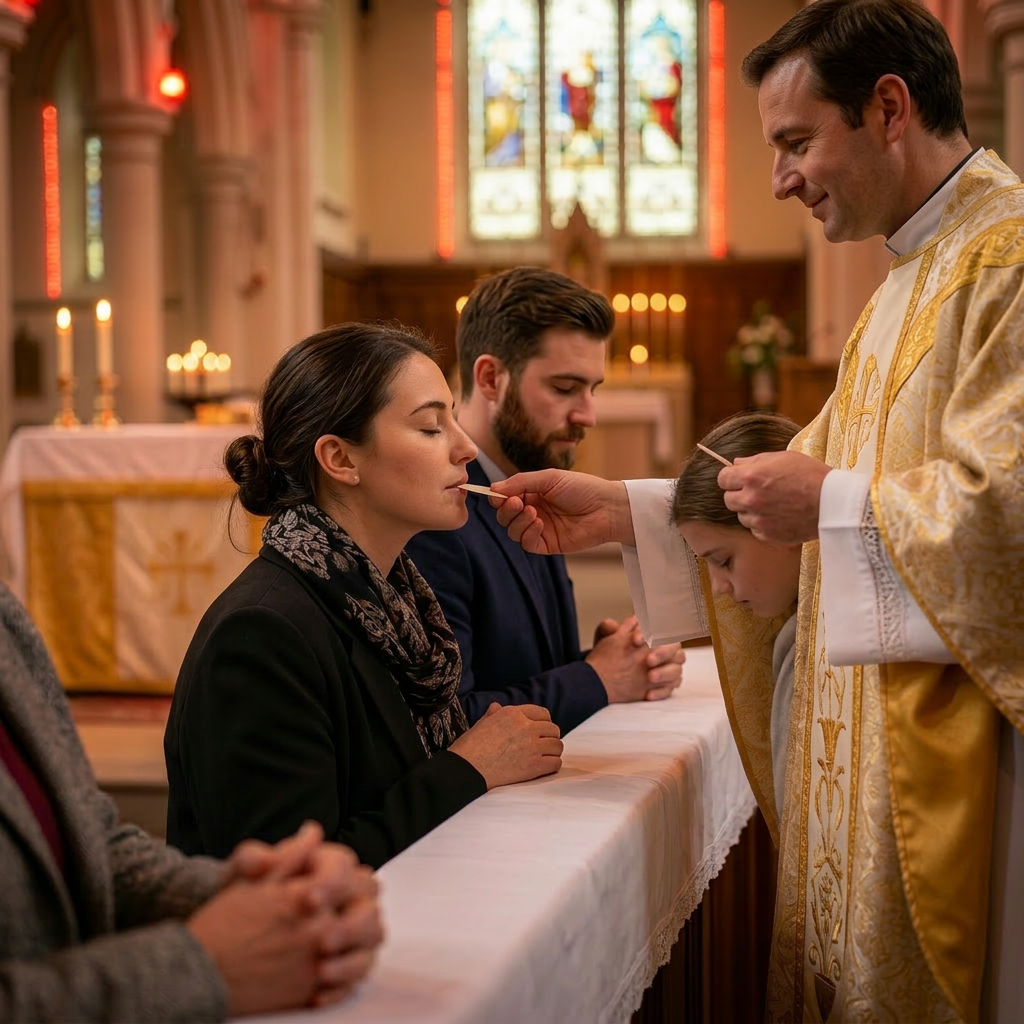
Every Sunday, in parishes across the world, Catholics who consider themselves devout — who attend Mass faithfully, who love God sincerely — walk to the altar and receive the Body of Christ in a state that Scripture calls a direct judgment upon themselves.
Not out of malice. Out of ignorance. Out of a faith formed more by cultural comfort than by the clear, unchanging teaching of the Church.
And nobody is telling them.
St. Paul did not soften this warning for the Corinthians, and the Holy Spirit does not soften it for us: “Whoever eats the bread or drinks the cup of the Lord unworthily will have to answer for the body and blood of the Lord… For anyone who eats and drinks without discerning the body, eats and drinks judgment on himself” (1 Corinthians 11:27–29).
That is not pastoral suggestion. That is the inspired Word of God.
The doctrine of mortal sin is one of the most important — and most abandoned — teachings in the Catholic Faith. In an age that has replaced the language of sin with the language of personal struggle and self-compassion, the Church’s clear teaching on grave sin feels jarring to many Catholics.
Good. It should.
Because clarity here is not cruelty. It is the deepest form of mercy — because a soul that understands what mortal sin is, is a soul equipped to seek the remedy God has provided.
That remedy exists. It is powerful. And it is waiting for you.
But first, you need to know the truth.
What Mortal Sin Actually Is
The word mortal means deadly.
Not inconvenient. Not regrettable. Deadly — because mortal sin kills the life of sanctifying grace in the soul.
The Catechism defines it precisely: mortal sin involves grave matter, committed with full knowledge and deliberate consent (CCC 1857). Three conditions. All three must be present. Miss one, and the sin — while possibly still serious — does not rise to the level of mortal.
Grave matter means the act must be seriously wrong — a genuine, significant violation of God’s law, not a minor fault or imperfection.
Full knowledge means sufficient awareness that what you are doing is gravely wrong. Not perfect theological training — but real, honest awareness.
Deliberate consent means the will freely chooses the act. Severe compulsion or extreme fear can diminish culpability. But where the will freely consents to grave matter with knowledge, all three conditions are met.
The result, in the Church’s own words: mortal sin “destroys charity in the heart of man by a grave violation of God’s law; it turns man away from God” (CCC 1855).
It does not wound the soul. It kills something in it.
This is not theological opinion or medieval severity. It is the consistent, unbroken teaching of the Church — upheld by every council, every pope, and every Doctor of the Faith across two thousand years.
The Church did not invent this teaching to control you. She received it to protect you.
And she is telling you now because she loves you enough to tell the truth.
The Sins Catholics Have Quietly Stopped Calling Sins
Here is where pastoral honesty becomes unavoidable.
Modern Catholic culture has developed a quiet, comfortable habit of mentally reclassifying certain grave sins as minor imperfections — or avoiding the examination altogether. This is not a development of conscience.
It is a betrayal of it.
Missing Mass on Sunday or a holy day of obligation without serious cause. The Catechism is unambiguous: “Those who deliberately fail in this obligation commit a grave sin” (CCC 2181). Not a moderate failing. A grave sin. The Sunday Mass is not one spiritual option among many — it is the cornerstone of Catholic life, and deliberate, unjustified absence is a serious matter before God.
Artificial contraception within marriage. Pope Paul VI’s Humanae Vitae — affirming the consistent teaching of the Church across centuries — identifies this as gravely contrary to the natural law and the ends of marriage. Widespread disagreement among Catholics does not change what the Church teaches.
A vote cannot override a doctrine.
Fornication and sexual activity outside of valid marriage. St. Paul lists these explicitly among the sins that exclude one from the Kingdom of God (1 Corinthians 6:9–10). Cultural normalization — even within Catholic circles — does not alter moral gravity. The world’s comfort with a sin is not the Church’s endorsement of it.
Deliberate, sustained hatred or grave injustice toward another. Scripture is clear that hatred of a brother or sister is incompatible with love of God (1 John 4:20). Grave calumny — deliberately destroying another’s reputation with falsehood — can rise to serious moral offense.
Involvement in the occult. Tarot cards, mediums, divination — even when treated as harmless entertainment — involve grave matter according to the Catechism (CCC 2116–2117). The casualness with which Catholics engage these practices is itself a sign of how far catechesis has collapsed.
A necessary clarification: the Church consistently distinguishes between the objective gravity of an act and the subjective culpability of the person. Ignorance, psychological factors, and circumstances can diminish personal responsibility. But they do not change the nature of the act — and they are not an excuse to stop examining your conscience.
St. Thomas Aquinas taught that a well-formed conscience does not invent exceptions. It aligns itself with truth.
Examine yours — honestly, courageously, and soon.
Receiving Holy Communion Unworthily – The Danger No One Talks About
Let this be said plainly, because too many pulpits have gone silent on it.
The Eucharist is not a symbol. It is not a spiritual metaphor or a community ritual. The Catholic Church teaches — as defined, irreformable dogma — that Jesus Christ is truly, really, and substantially present in the Eucharist: Body, Blood, Soul, and Divinity, under the appearances of bread and wine.
If that is true — and it is — then receiving Him unworthily is not a minor liturgical oversight. It is a sacrilege.
St. Paul did not merely suggest caution in 1 Corinthians 11. He reported consequences — illness and death — among those who received unworthily. The stakes are not merely interior. They are eternal.
Receiving Communion does not neutralize mortal sin. It compounds it.
This truth has been quietly buried under decades of a Communion culture that treats the Eucharist as the automatic conclusion to every Mass attendance — a participation trophy distributed regardless of the interior state of the recipient.
It is one of the most damaging habits in the modern Church.
It is robbing Catholics of reverence for the Eucharist — and of any urgency about the state of their own souls.
Canon 916 of the Code of Canon Law is unambiguous: a person conscious of grave sin is not to receive Holy Communion without previously going to sacramental Confession.
This is not a punitive rule. It is a protective one.
It protects the dignity of Christ in the Eucharist. It protects the soul of the communicant. And it orders the faithful toward the one sacrament — Confession — that actually heals what mortal sin has damaged.
The solution to unworthiness is not to avoid the Eucharist. It is to become worthy — through Confession, contrition, and grace.
The Sacrament of Confession: God’s Answer to Mortal Sin
Here is the truth the devil works hardest to keep you from believing:
No matter what you have done, the mercy of God in Confession is greater.
The existence of mortal sin is not the end of the story. It is the beginning of a mercy that defies comprehension. God, who could have left mankind to the permanent consequences of grave sin, instead gave the Church the Sacrament of Penance — a tribunal not of condemnation, but of healing.
In Confession, the absolution spoken by the priest is not a human formality. It is the voice of Christ Himself declaring over your soul: your sins are forgiven.
St. John Vianney — the patron of parish priests, who spent up to sixteen hours a day in the confessional and drew souls from across Europe — understood what modern Catholics have largely forgotten.
Confession is not a spiritual formality. It is a personal encounter with the mercy of Christ.
The effects of a worthy Confession are total and real: reconciliation with God, restoration of sanctifying grace, peace of conscience, spiritual strength against future temptation, and reconciliation with the Church (CCC 1496).
Every one of those gifts is available to you. Right now. This week.
St. John Vianney said: “If people really understood the value of the Sacrament of Penance, they would not avoid it — they would run to it.”
For a soul in mortal sin, Confession is not optional. It is urgent. An act of perfect contrition can restore the soul to grace in extraordinary circumstances — but the obligation to confess remains, and must be fulfilled at the earliest opportunity (CCC 1456).
The confessional is not where your worst moments define you. It is where grace redefines you.
Do not let shame keep you away. Do not let pride keep you away. Do not let the lie that you have been gone too long keep you away.
The longer you have been away, the more urgently you need to return.
What You Should Do If You Are In Mortal Sin
If something in this article has stirred your conscience — do not suppress it.
That stirring is the Holy Spirit. And it deserves a response.
Step 1: Make an honest examination of conscience. Sit quietly before God and examine your life against the Ten Commandments and the Church’s teaching. Not a skim. Not a rationalization. A genuine, courageous inventory. Printed examinations of conscience are widely available — use one tonight.
Step 2: Make an act of contrition. Awaken real sorrow for your sins — not merely because of their consequences, but because they offend God, who is all good and deserving of all love. This is where conversion begins. This is where the soul starts turning back toward home.
Step 3: Go to Confession as soon as possible. Not next month. Not when you feel ready. Find a priest and go. If you have been away for years and are unsure how to proceed, simply tell the priest — he will guide you without judgment. That is precisely what he is ordained to do.
Step 4: Make a firm purpose of amendment. A valid Confession requires sincere intention to avoid the sin and its near occasions going forward. Not guaranteed perfection — genuine, honest resolve before God.
Step 5: Return to the Eucharist worthily. After a good Confession, approach the altar with the reverence and joy of a soul restored. Receive the Lord not as routine, but as the most intimate union with God available to a human being on this earth.
One good Confession can change the entire trajectory of your soul.
Do not underestimate what God can do with a contrite heart.
The Mercy that Waits for You
Nothing in this article exists to condemn you.
It exists to tell you the truth — because the truth is the only road that leads to freedom.
The Church teaches these realities about mortal sin precisely because she believes in a mercy powerful enough to heal every one of them. Every saint was once a sinner in need of grace. The difference between a saint and a lost soul is not the absence of sin — it is the response to it.
God is not waiting with a verdict. He is waiting with open arms.
But He will not pretend that grave sin is something other than what it is — because to do so would diminish the Cross and treat the Blood of His Son as an ordinary thing. He loves you too much for comfortable lies.
He takes your soul seriously enough to tell you the truth. And the truth is this: some sins are deadly, receiving His Body unworthily is dangerous, and the door of His mercy is standing open right now for anyone willing to walk through it.
St. John Vianney — who had witnessed more sin and more repentance than perhaps any priest who ever lived — painted this image of God’s mercy: “God is more ready to forgive than a mother is to snatch her child from the fire.”
That is the God who is waiting for you in Confession.
Not someday. Not after you have improved. Not when life slows down.
Now.
Don’t Let Another Sunday Pass By
The stakes of this teaching are not theological abstractions.
They are your soul. They are the souls of your spouse, your children, your closest friends — people who may be walking to that altar every Sunday carrying what they cannot afford to carry there.
Tell them. Share this article. Have the conversation that comfort would rather avoid. The charity that stays silent to preserve peace is not charity at all.
Silence about sin is not kindness. It is abandonment.
And if God has spoken to you today through these words — if your conscience has stirred even slightly — do not silence it, do not defer it, do not negotiate with it.
Go to Confession. Receive the Eucharist worthily. Begin again.
God’s mercy is real. It is vast. It is personal. And it is not waiting for a better version of you — it is waiting for the honest, broken, willing version of you that is sitting here right now.
“Now is the acceptable time. Now is the day of salvation” (2 Corinthians 6:2).
The door is open. Your soul is waiting. Eternity is not.
Walk through it — before another Sunday passes.
If this article moved you, share it with a Catholic who needs to hear it. And make one decision right now — not after the weekend, not when life slows down — to go to Confession this week. Your soul is worth the twenty minutes it takes.

0 comments on “Most Catholics Don’t Realize This Is a Mortal Sin”