
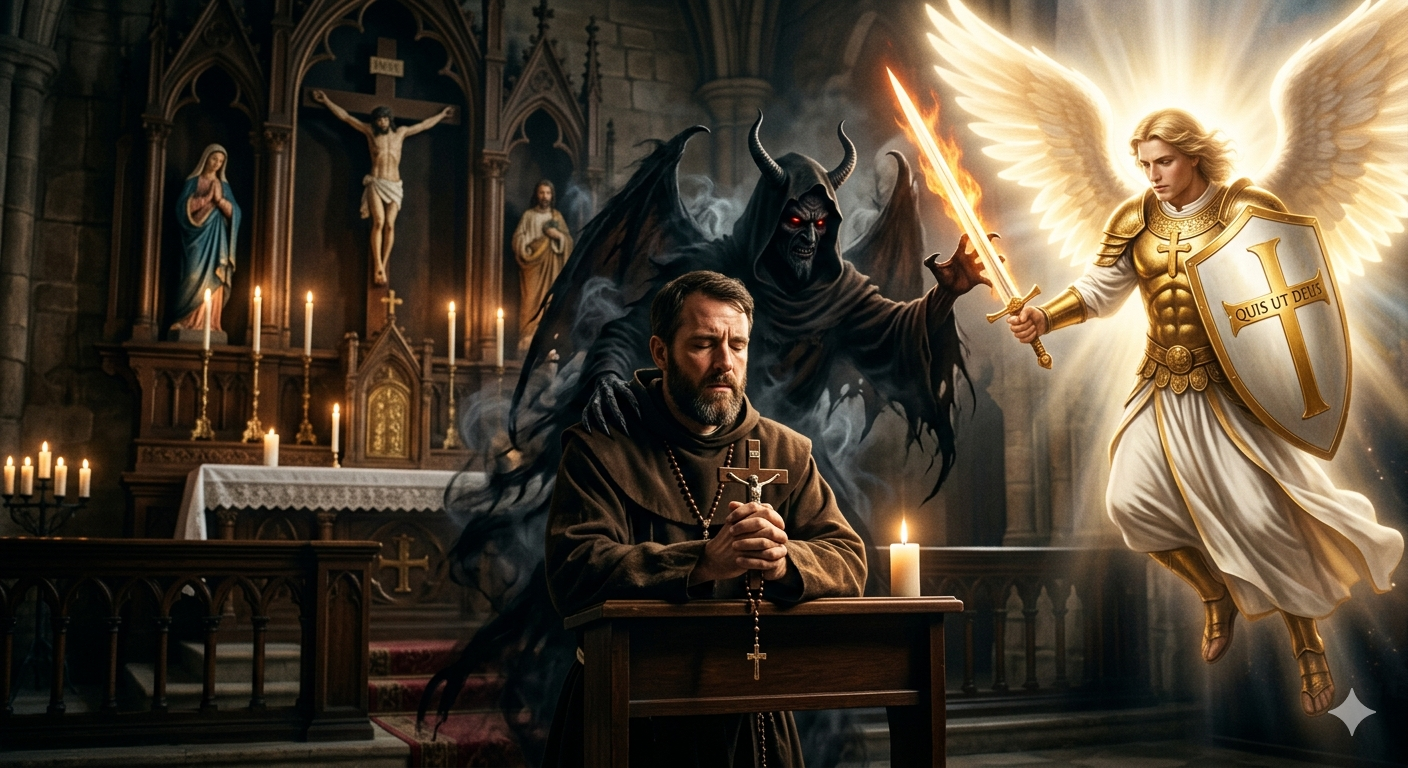

5 Ways the Devil Attacks You Daily (And How to Fight Back)
He doesn’t need you to become a monster. He just needs you to get a little busier.
A little more distracted. A little more comfortable. A little more willing to put off until tomorrow the prayer you skipped today.
Most Catholics don’t lose their faith in a single dramatic moment of crisis. They lose it quietly — scroll by scroll, excuse by excuse, one lukewarm Sunday at a time. And the terrifying part? They barely notice it happening.
This is not an accident. It is a strategy.
The devil is not trying to make you evil. He’s trying to make you indifferent. And indifference is working.
If this is speaking to you, read through these 5 Ways the Devil Attacks You Daily (And How to Fight Back).
Make no mistake, the devil is real. He is not a metaphor. He is not a medieval superstition invented to frighten peasants into obedience. He is a personal, intelligent, ancient being whose singular obsession is the destruction of your soul — and he has been studying you far longer than you have been studying him.
St. Peter, the first Pope, wrote with the urgency of a man who had seen evil up close: “Be sober and vigilant. Your opponent the devil is prowling around like a roaring lion looking for someone to devour” (1 Peter 5:8). St. Paul — writing to ordinary Christians living ordinary lives — warned them plainly: “Our struggle is not with flesh and blood but with the principalities, with the powers, with the world rulers of this present darkness” (Ephesians 6:12).
Spiritual Warfare is Not Reserved for Mystics and Exorcists
Spiritual warfare is not reserved for mystics and exorcists. It is the condition of every baptized soul.
The question is not whether you are in this battle. The question is whether you are fighting — or whether you have already surrendered without realizing it.
Here are the five ways the devil is attacking you right now. Today. In the middle of your ordinary life.
1. Distraction: He Doesn’t Need Your Soul — He Just Needs Your Attention
Let’s say something the comfortable Catholic culture rarely says out loud.
Your phone may be doing more damage to your spiritual life than any temptation you’ve consciously resisted.
The average person touches their phone over 2,600 times a day. How many of those touches are directed toward God? The devil doesn’t need you to open a portal to darkness. He just needs you to check your notifications one more time before you pray — and then watch the hour disappear.
This is his first and most efficient weapon: not sin, but noise. Not wickedness, but busyness.
Distraction is the enemy’s favorite disguise.
He fills your life with so many things that the one essential thing quietly falls away.
St. Ignatius of Loyola, the great architect of spiritual discernment, identified this tactic precisely. The enemy works first not through obvious evil but through distraction from what is best. He crowds out eternity with the immediate. He replaces the silence where God speaks with an endless feed of things that will not matter on your deathbed.
When prayer becomes irregular, grace becomes scarce. When grace becomes scarce, the soul loses its footing — slowly, imperceptibly, until it is standing somewhere it never intended to be.
A soul that does not pray is a soul that has already begun to lose the battle.
Do you realize how long it has been since you sat in genuine silence before God? Not distracted silence. Real silence, offered to Him, waiting for Him?
The Catholic response: Take your morning back. Before the phone. Before the news. Before the noise. Ten minutes of prayer at the start of your day is not a luxury — it is spiritual armor. The Rosary, the Divine Office, a simple Act of Consecration — any of these, prayed with intention, reorients your entire day around God rather than yourself.
The devil hates the soul that begins the morning on its knees. So begin there.
2. Discouragement: His Most Underestimated Weapon
You fell again.
Maybe it was the same sin you confessed last month. And the month before that. A flash of rage, a return to an old habit, a moment of weakness you swore would never happen again.
And right on cue, the voice arrives.
“You’ll never change. God is exhausted with you. You’ve asked forgiveness too many times. What’s the point of going back?”
That voice is not your conscience. It is your enemy.
Discouragement is not humility. Humility says, “I have sinned — I will rise and return to my Father.” Discouragement says, “I have sinned — I am beyond rescue.” One leads to the confessional. The other leads to despair. And despair is among the gravest of spiritual conditions because it constitutes a direct rejection of God’s mercy.
Bl. Padre Pio — who spent decades in the confessional and had seen every shade of human sin — said something that should be engraved on every Catholic’s heart: the greatest obstacle to holiness is not sin, but the discouragement that follows sin.
The saints fell. Every single one of them. What made them saints was not that they stopped falling — it was that they refused to stay down.
Every fall is an invitation. The question is where it leads you.
Every time you drag yourself back to Confession, the devil loses. He cannot stand it. The tribunal of mercy is the one place in the universe where his accusations are permanently silenced.
The Catholic response: Go to Confession — not when you feel worthy, but precisely because you are not. Stop waiting until you have yourself together. That is like refusing to go to the hospital until you are already healthy. Go wounded. Go ashamed. Go as many times as it takes.
God is not keeping a tally of your failures. He is keeping watch for your return.
3. Temptation: He Knows You Better Than You Know Yourself
This is where it gets personal.
The devil does not run the same play on every soul. He studies you. He knows your history — the wounds that haven’t healed, the patterns you keep repeating, the particular door in your soul that swings open most easily under pressure.
And he does not kick that door down. He knocks politely.
He rarely invites you to leap into mortal sin. He just invites you to take one small step.
Just this once. Just to take the edge off. It’s not that serious. You’ve had a hard week — surely God understands.
St. Thomas Aquinas mapped the progression with devastating clarity: temptation entertained becomes desire, desire nurtured becomes consent, consent repeated becomes habit, habit calcified becomes vice. What feels like a small step today is the foundation of a prison being built around your soul.
Sin does not usually announce itself. It arrives wearing ordinary clothes.
In our particular moment, this looks like the video that leads to the next, the conversation that slides into detraction, the quiet resentment that gets fed instead of surrendered, the comfort that becomes an idol so gradually you never see it happening.
Here is the uncomfortable question every Catholic must ask honestly: What is the particular door in my soul that I keep leaving unlocked? What is the temptation I keep half-heartedly resolving to fight but have never brought before God in real prayer, real fasting, and real decisiveness?
The Catholic response: Name it. Confess it specifically — not vaguely. Build concrete defenses: if an app is a portal to sin, delete it tonight. If a situation is an occasion of sin, avoid it without negotiation. Fast. The Church has always known that fasting weakens disordered appetite in a way that willpower alone never can. Pray the Rosary daily.
Do not negotiate with temptation. Flee it. Every time, without exception.
4. Confusion: When He Can’t Make You Wicked, He Makes You Uncertain
Here is perhaps the most sophisticated weapon in his modern arsenal.
He does not always need you to sin flagrantly. Sometimes all he needs is to make you uncertain enough that you no longer know what sin is.
We live in a moment of staggering moral disorientation. Evil is rebranded as compassion. Virtue is rebranded as intolerance. The clear moral teaching of the Church — unchanged across two millennia, rooted in Divine Revelation — is dismissed as culturally conditioned or just one opinion among many.
And some of this confusion has crept inside the Church herself. That is not conspiracy — it is prophecy fulfilled.
Pope Leo XIII, after a reported vision of the battle between St. Michael and the powers of darkness, composed the Prayer to St. Michael as a weapon for the modern age. He understood that the enemy’s strategy would be not persecution but infiltration — confusing the faithful, softening doctrine, blurring the line between the Church and the world until the two become indistinguishable.
A confused Catholic is a disarmed Catholic.
When doctrine feels negotiable and moral truth feels relative, you cannot defend yourself, your marriage, your children, or your home from the enemy’s advance. You cannot pass on a Faith you are uncertain of.
Truth is not a feeling. Truth is a Person. And that Person has not changed His mind.
The Catholic response: Return to the sources. Read the Catechism of the Catholic Church — the actual text, not someone’s comfortable summary of it. Read the Gospels. Read the Fathers. Know why the Church teaches what she teaches, and hold it with the serene, unmovable conviction of a soul anchored in Revelation.
When confusion surrounds you, your clarity becomes an act of resistance.
5. Lukewarmness: The Devil’s Masterpiece
Save the most dangerous for last.
Not because it is the most dramatic — but because it is the most common, the most comfortable, and the most difficult to diagnose. It requires no crisis. No dramatic fall. It simply requires that you stop caring deeply about the things of God.
The lukewarm Catholic still goes to Mass. Still says he believes. Still considers himself decent, better than most. He has simply — quietly, gradually, painlessly — stopped burning.
He is not in obvious sin. He is just no longer in love.
The hunger for the Eucharist has become routine. The examination of conscience has been replaced by a vague feeling of being basically fine. The zeal of first conversion, the fire of genuine love for God — all of it has cooled into spiritual room temperature.
And room temperature is exactly where the devil wants you.
Comfort is where zeal goes to die.
Our Lord did not speak gently about this. In the Book of Revelation, He addressed the lukewarm soul with words that should wake every comfortable Catholic from their slumber: “Because you are lukewarm — neither hot nor cold — I will spit you out of my mouth” (Revelation 3:16).
Not the obviously wicked. The comfortably mediocre.
Here is the uncomfortable truth that Catholic culture rarely speaks plainly: attending Sunday Mass while living the rest of your week entirely on your own terms is not Catholicism. It is a performance of Catholicism. And on the last day, the difference between the two will matter infinitely.
The lukewarm soul does not feel endangered because it is not in obvious sin. It is not falling. It is simply not moving. And in the spiritual life, not moving is its own form of death — because the soul was not made for stasis.
You were not made for spiritual room temperature. You were made for God. And nothing less will ever be enough.
Are you growing in holiness this year? Are you more prayerful, more charitable, more self-controlled than you were twelve months ago? If the honest answer is no — what are you prepared to do about it?
The Catholic response: Refuse to settle. Make a retreat. Spend a full hour before the Blessed Sacrament with your honest, unglamorous spiritual state laid bare before God. Begin a daily examination of conscience. Read the lives of the saints — not as distant inspirational figures, but as proof of what grace can actually accomplish in a soul that cooperates with it. Ask God sincerely to set you on fire.
He will answer that prayer. He always does. But you have to mean it.
5. Lukewarmness: The Devil’s Masterpiece
Save the most dangerous for last.
Not because it is the most dramatic — but because it is the most common, the most comfortable, and the most difficult to diagnose. It requires no crisis. No dramatic fall. It simply requires that you stop caring deeply about the things of God.
The lukewarm Catholic still goes to Mass. Still says he believes. Still considers himself decent, better than most. He has simply — quietly, gradually, painlessly — stopped burning.
He is not in obvious sin. He is just no longer in love.
The hunger for the Eucharist has become routine. The examination of conscience has been replaced by a vague feeling of being basically fine. The zeal of first conversion, the fire of genuine love for God — all of it has cooled into spiritual room temperature.
And room temperature is exactly where the devil wants you.
Comfort is where zeal goes to die.
Our Lord did not speak gently about this. In the Book of Revelation, He addressed the lukewarm soul with words that should wake every comfortable Catholic from their slumber: “Because you are lukewarm — neither hot nor cold — I will spit you out of my mouth” (Revelation 3:16).
Not the obviously wicked. The comfortably mediocre.
Here is the uncomfortable truth that Catholic culture rarely speaks plainly: attending Sunday Mass while living the rest of your week entirely on your own terms is not Catholicism. It is a performance of Catholicism. And on the last day, the difference between the two will matter infinitely.
The lukewarm soul does not feel endangered because it is not in obvious sin. It is not falling. It is simply not moving. And in the spiritual life, not moving is its own form of death — because the soul was not made for stasis.
You were not made for spiritual room temperature. You were made for God. And nothing less will ever be enough.
Are you growing in holiness this year? Are you more prayerful, more charitable, more self-controlled than you were twelve months ago? If the honest answer is no — what are you prepared to do about it?
The Catholic response: Refuse to settle. Make a retreat. Spend a full hour before the Blessed Sacrament with your honest, unglamorous spiritual state laid bare before God. Begin a daily examination of conscience. Read the lives of the saints — not as distant inspirational figures, but as proof of what grace can actually accomplish in a soul that cooperates with it. Ask God sincerely to set you on fire.
He will answer that prayer. He always does. But you have to mean it.
How to Fight Back — Starting Today
Stop treating these as suggestions. They are weapons. Pick them up.
Daily prayer — without exception. Before the phone. Before the day begins. Ten minutes of sincere morning prayer does more to fortify your soul than an hour of anxious self-improvement. Guard that time like your life depends on it — because in the deepest sense, it does.
Go to Confession — this week. Not next month. This week. Regular Confession is the single most underused weapon in the Catholic arsenal. It breaks the grip of habitual sin, restores sanctifying grace, and delivers the soul from exactly the discouragement and spiritual numbness the enemy cultivates. There is no substitute. None.
Pray the Rosary daily. Our Lady did not suggest the Rosary at Fatima — she pleaded for it. Fifteen minutes. Every day. This is non-negotiable for the soul that takes its own salvation seriously.
Fast. Christ said certain spirits are cast out only by “prayer and fasting” (Matthew 17:21). The traditional Catholic practice of Friday fasting is not antique piety — it is combat training for the will. Reclaim it. Your appetites must serve your soul, not rule it.
Use your sacramentals. Holy water in your home. The Brown Scapular worn with faith. A blessed crucifix above your door. These are not decorations. They are sacramental signs of your belonging to Christ — and the devil despises every single one of them.
Know your Faith. Read the Catechism. Read Scripture. An informed soul cannot be confused into surrendering what it knows to be true. In spiritual warfare, ignorance is not innocence — it is vulnerability.
The Prayer of St. Michael the Archangel
Pray this daily. Pray it with your family. Pray it when the attack is obvious — and when it isn’t, because the battle does not pause simply because you have stopped noticing it.
Saint Michael the Archangel, defend us in battle. Be our protection against the wickedness and snares of the devil. May God rebuke him, we humbly pray; and do thou, O Prince of the Heavenly Host, by the power of God, cast into hell Satan and all the evil spirits who prowl about the world seeking the ruin of souls. Amen.
Wake Up. The Battle Is Real — And So Is the Victory.
Let this land before you close this page.
The devil is not a metaphor for bad days and negative thinking. He is a real being conducting a real campaign against your real soul — and against your marriage, your children, your home, and everyone you have the power to lead toward or away from God.
He has weaponized your comfort, your busyness, your discouragement, and your mediocrity against you.
And if we are ruthlessly honest — it has been working.
But here is what he has never been able to survive:
A soul that knows it is at war, picks up its weapons, and refuses — absolutely refuses — to quit.
The Resurrection is not a symbol. It is the definitive, total defeat of sin, death, and every principality of darkness. Christ did not merely survive the enemy’s worst — He destroyed it. Every time you receive the Eucharist, you receive the Body of the Victor. Every absolution in Confession is the enemy’s grip broken by the authority of Christ Himself. Every Rosary is a battle won under the mantle of the woman whose heel is on the serpent’s head.
You are not fighting as an orphan. You are fighting as a child of God.
Armed with the sacraments. Guarded by angels. Interceded for by the Queen of Heaven.
But you have to actually fight. Grace is not passive. The saints were not passive.
And neither can you be.
Go to Confession this week. Pray the St. Michael Prayer tonight. Put down the phone and pick up your Rosary. Have the honest conversation with God that you have been quietly avoiding.
The devil is counting on your delay.
Prove him wrong — starting today.
If this article stirred something in you, share it with a Catholic who needs to hear it. And before you close this page, commit to one concrete act of spiritual combat today — not tomorrow, not after the weekend. Today. The battle is real. The victory is real. And your soul is worth fighting for.

0 comments on “5 Ways the Devil Attacks You Daily (And How to Fight Back)”