

Reviving Your Faith: 7 Tell-Tale Signs for Lukewarmness (And How To Wake Up)
A soul rarely drifts from God all at once.
There is no dramatic moment. No single decision. No obvious turning point you can look back on and say — that was when it happened.
It happens the way a fire goes out. Not with a sudden dousing of water, but with a slow failure to add fuel. One prayer skipped. One Sunday that felt like going through the motions. One examination of conscience quietly dropped. One month becoming two without Confession — and then you stop counting the months altogether.
And then one day you realize: the fire that once burned is barely an ember. And you are not entirely sure when it happened.
This is lukewarmness. And it is far more common — and far more dangerous — than most Catholics realize.
Our Lord reserved His most sobering words not for the openly wicked, but for the spiritually tepid. In the Book of Revelation, He addressed the lukewarm soul with words that should stop every comfortable Catholic cold: “Because you are lukewarm — neither hot nor cold — I will spit you out of my mouth” (Revelation 3:16).
Not the rebels. Not the doubters. The comfortable. The indifferent. The ones who kept showing up but stopped truly seeking.
Could that be you? Could it be happening right now — so gradually you haven’t noticed?
Read these signs honestly. Let the Holy Spirit do what He came to do.
Sign 1: Prayer Has Become Optional
There was a time — perhaps in your first conversion, or after a powerful retreat, or in a moment of crisis — when prayer felt urgent. Necessary. Like oxygen.
Now it is the first thing dropped when life gets busy.
When prayer becomes optional, God has become optional. We rarely admit that — but it is what the choice reveals.
The soul that is spiritually alive prays because it cannot imagine not praying. The soul growing lukewarm prays when it is convenient, when it feels like it, when nothing more pressing takes precedence. And there is always something more pressing.
Our Lord’s instruction was not “pray when you feel inspired” — it was “pray always and do not lose heart” (Luke 18:1). St. Paul commanded: “Pray without ceasing” (1 Thessalonians 5:17). Not as spiritual professionals, but as ordinary people who understand that connection with God is not a supplement to daily life. It is its foundation.
Ask yourself honestly: Is prayer the first thing you give to God each day — or the last thing you get to?
Sign 2: Confession Has Quietly Disappeared
When did you last go to Confession?
If the answer requires real effort to remember — that is a sign.
The lukewarm soul develops a practiced ease with unconfessed sin. Not a comfort, exactly — more of a tolerance. The sharp edge of conscience dulls. What once caused genuine contrition now barely registers. The intention to go to Confession remains perpetually in place, perpetually deferred.
This is one of the enemy’s most effective long-term strategies — not to make you love sin, but to make you comfortable with it.
St. John Vianney understood the confessional as the front line of spiritual warfare. He spent his life there because he knew what unconfessed sin does to a soul over time — not dramatically, but steadily. It hardens. It distances. It makes God feel further away than He is.
The Catechism recommends Confession at least once a year as the bare minimum — and the saints treated that minimum as a starting point for beginners, not a ceiling for the serious. A soul growing in holiness runs to Confession. A soul growing lukewarm avoids it.
When is your next Confession?
Sign 3: Mass Has Become a Routine, Not an Encounter
You are in the pew. You say the responses. You receive Communion. You leave.
And somewhere between the entrance antiphon and the final blessing, nothing happened in your soul. Not because God was absent — He was not. But because you were not fully present to Him.
The greatest scandal of modern Catholic life may not be those who have left the Faith — it may be those who have stayed but stopped arriving.
The Holy Sacrifice of the Mass is the most sublime act of worship available to a human being on this earth. At every Mass, Christ offers Himself to the Father. The Calvary of two thousand years ago becomes present, real, and efficacious on the altar before you. The God of the universe descends under the appearance of bread and wine and gives Himself to you.
Does your interior life at Mass reflect that reality?
St. John Fisher — martyr and bishop — said he would rather lose his head than lose the Mass. Many modern Catholics would sooner lose the Mass than lose their weekend plans.
If attendance has replaced participation — if presence has replaced encounter — something essential has been lost.
Sign 4: Silence Has Been Replaced by Constant Distraction
The lukewarm soul is almost always a noisy soul.
Not necessarily noisy in speech — but internally crowded. Perpetually stimulated. Structurally incapable of the silence in which God most naturally speaks.
A soul that cannot tolerate silence cannot hear God. And a soul that cannot hear God cannot grow.
There is a reason the great spiritual traditions of the Church — Benedictine, Carmelite, Dominican — all place silence at the center of the interior life. Not as an ascetic curiosity, but as a spiritual necessity. In silence, the soul meets itself. And in meeting itself honestly, it meets its need for God.
Modern life has engineered the elimination of this silence. And many Catholics have accepted that elimination without a single act of resistance — filling every quiet moment with screens, sound, and stimulation, then wondering why prayer feels hollow and God feels distant.
Distraction is not neutral. It is the enemy of interiority. And interiority is where faith lives.
Sign 5: Comfort Has Replaced Sacrifice
Our Lord’s invitation to discipleship was never ambiguous: “If anyone wishes to come after me, he must deny himself, take up his cross daily, and follow me” (Luke 9:23).
Daily. Not occasionally. Not when it is convenient. Daily.
The lukewarm Catholic has quietly renegotiated these terms. The cross has been lightened — or set down entirely — in favor of a Christianity that fits comfortably around an already comfortable life. Fasting has been abandoned. Mortification is considered extreme. The traditional disciplines of Lent have been reduced to the merely symbolic.
Comfort is not a sin. But comfort pursued as the primary goal of life is incompatible with the Gospel.
St. John of the Cross wrote that the soul cannot reach union with God while clinging to its own ease. The cross is not an obstacle to holiness — it is the path to it. Every saint understood this. Every lukewarm soul has forgotten it.
What voluntary sacrifice exists in your life right now? What do you deny yourself for the love of God?
If the answer is nothing — that is a sign worth sitting with.
Sign 6: The Desire for Holiness Has Faded
There was a time, perhaps, when you wanted to be a saint.
Not as a fantasy — but as a genuine, burning desire to give everything to God. To be transformed. To live differently, love more radically, pray more deeply.
That desire may have faded so gradually you barely noticed it leave.
The greatest danger is not rebellion. It is indifference — the quiet death of holy desire.
The lukewarm soul still wants heaven, in an abstract sense. It simply no longer wants to pay the price of transformation. It wants the destination without the journey. The crown without the cross.
But holiness is not a status conferred at death upon those who avoided obvious wickedness. It is a life actively, daily, sacrificially pursued. “Blessed are those who hunger and thirst for righteousness” (Matthew 5:6) — not those who have settled for being basically decent.
Do you still hunger? If the honest answer is barely — let that honesty be the beginning of something.
Sign 7: Cultural Catholicism Has Replaced Discipleship
This is the sign that is hardest to see — because it looks so much like the real thing.
Cultural Catholicism has a Catholic identity, uses Catholic language, appears in Catholic spaces — but is oriented around belonging rather than transformation. It identifies with the Church without submitting to her. It appreciates the tradition without being formed by it.
Being Catholic is not an ethnicity. It is not an inheritance. It is a daily, personal, costly decision to follow Jesus Christ.
Our Lord did not say “come and identify as my disciple.” He said “follow me” — an active, present-tense, moving instruction. Discipleship is not a static condition. It is a direction. And the lukewarm soul has quietly stopped moving in it.
The uncomfortable question is not “am I Catholic?” but “am I becoming more like Christ this year than last?”
How to Spiritually Wake Up
The ember is not dead. Even the smallest ember can become a fire — with the right attention, the right fuel, and the grace of God.
Here is where to begin.
Go to Confession — this week. Not next month. This week. Whatever distance has accumulated between your soul and God, the confessional closes it. Go with honesty and contrition. Let the grace of absolution do what it was designed to do.
Make a serious examination of conscience. Not a quick mental scan — a real, written, honest accounting of your spiritual state. Use a traditional Catholic examination of conscience. Look clearly at what has drifted. Name it before God.
Restore daily prayer — with structure. The Morning Offering. The Rosary. A decade of the Divine Office. Choose a form and commit to it daily, without exception, for thirty days. Watch what begins to shift.
Fast. Choose one voluntary sacrifice this week — and offer it explicitly for the rekindling of your love for God. Fasting reorders the will. It reasserts the soul’s sovereignty over the body’s appetites. It is one of the most direct paths back to spiritual alertness.
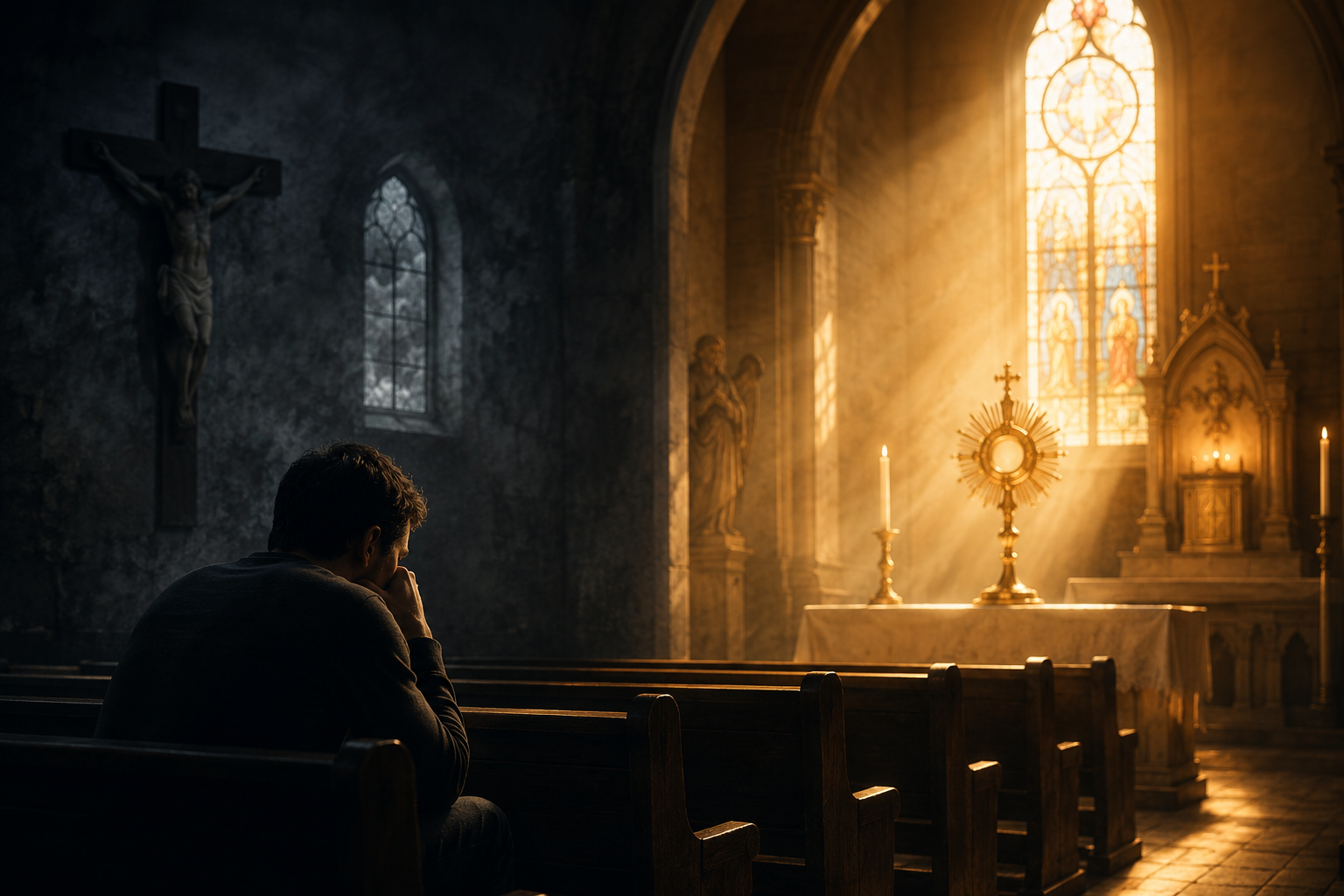
Spend time before the Blessed Sacrament. One holy hour — or even thirty minutes — of Eucharistic Adoration can do more for a spiritually numb soul than a month of half-hearted prayer. Bring your lukewarmness before the Lord and let Him deal with it.
Read the lives of the saints. Not as historical curiosities — as models of what grace looks like when it is fully cooperated with. Let their fire kindle yours. St. Teresa of Ávila. St. Francis of Assisi. St. John Vianney. Pick one and read.
Reduce digital noise — deliberately and immediately. The soul cannot wake up in constant distraction. Even one hour of genuine silence per day begins to restore interior depth. Protect it fiercely.
The Ember is Not Dead
Lukewarmness is serious. Our Lord’s words in Revelation are not comfortable, and they are not meant to be.
But they are spoken by a God who still addresses the lukewarm — who still knocks, still calls, still pursues even the soul that has drifted furthest into spiritual mediocrity.
The fact that you are reading this article may itself be an act of grace.
He is not finished with you. He has never been finished with you. The same Lord who said “I will spit you out” also said “Come to me, all who are weary” — and He meant both, and He means both for you, right now.
The path back to fervor is not complicated. It is not reserved for the spiritually gifted or the naturally devout.
It begins with honesty. It continues with one step — one prayer, one Confession, one holy hour — taken today rather than deferred to tomorrow.
Give Him the ember. He has never needed more than that to start a fire.
A Prayer for Spiritual Renewal and Holy Zeal
Lord Jesus Christ, I confess to You what I have been reluctant to admit to myself: I have grown cold.
The fire that once burned in me has dimmed through comfort, distraction, and the slow drift of days spent looking everywhere but toward Your face.
Forgive me, Lord, for the prayers I have skipped, the Confessions I have deferred, the Masses I have attended in body but not in soul. Forgive me for preferring ease to the cross and routine to encounter.
I do not want to be lukewarm. I do not want to stand before You and discover I spent my life almost following You.
Set me on fire again, Lord. Restore in me a hunger for holiness that I cannot silence and will not suppress. Make me restless for You — dissatisfied with mediocrity, impatient with my own complacency, desperate for the intimacy with You that I was created to enjoy.
Holy Spirit, breathe on the embers of my soul. Our Lady, Untier of Knots, loosen whatever holds me back from full surrender. St. John Vianney, pray for me — you who burned with love for God and never stopped calling souls to return.
Lord, I give You what I have. It is not much. But You have always been able to do everything with very little.
Rekindle me. I am ready.
Amen.
If this article stirred something in you, do not let the feeling pass without acting on it. Share it with a Catholic who may need to hear it. And make one decision today — Confession, a holy hour, a restored Rosary — that begins the return. The fire is not out. God is not finished. Start today.

0 comments on “Reviving Your Faith: 7 Tell-Tale Signs for Lukewarmness (And How to Wake Up)”