

Why Catholics Pray the Rosary Every Day (The 15 Extraordinary Promises)
For centuries, Catholics have reached for their Rosaries for all different kinds of reasons whether obedience, the will to grow deeper in their spiritual lives, or during times of war, beside hospital beds, during family crises, when tempted, when grieving, when simply desperate for peace. Generations have held the same beads and prayed the same mysteries of Christ as found in Holy Scripture.
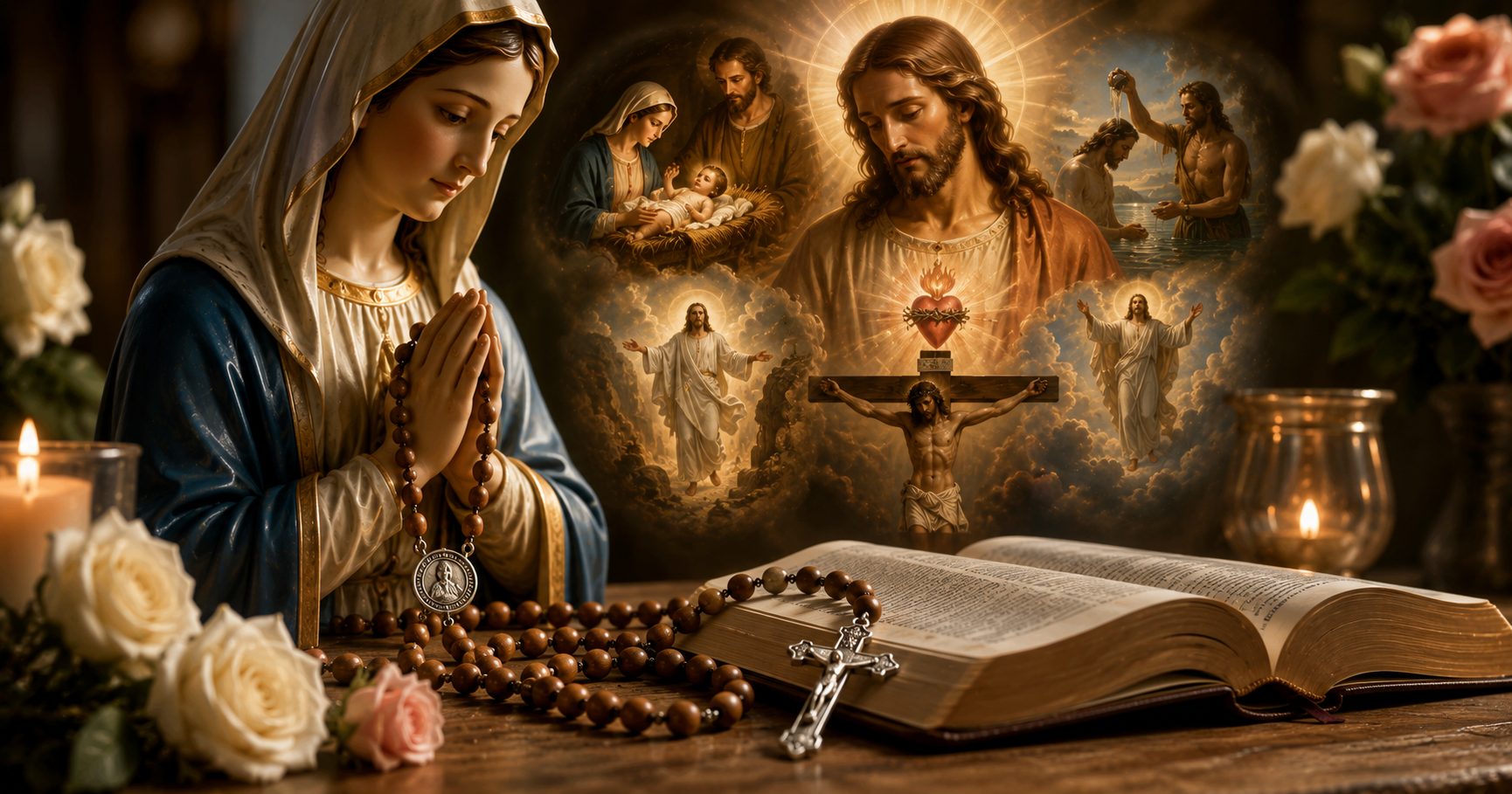
So why has the Church cherished this simple prayer so deeply? The answer involves far more than simple family tradition. The Rosary is a meditation upon the life, death, and glory of Jesus Christ, seen through the eyes of His Mother.
Why Catholics Pray the Rosary
Simply put, the Rosary comes from Our Lady herself. Catholics do not worship Mary; we honor her because she is the Mother of God and now our Mother as well (given to us by Christ Himself). The prayer she gave us to pray, the Rosary, is Christ-centered from its very words: “Blessed is the fruit of thy womb, Jesus.” While the lips repeat the familiar prayers throughout, the mind meditates on the divine mysteries of Christ — His Incarnation, ministry, Passion, Resurrection, and glory. Authentic Marian devotion always leads us back to her Son.
Where Did the Rosary Come From
The Rosary’s roots stretch back to the ancient Christian practice of repeated vocal prayer using knotted cords, as well as to the “Marian Psalter” — 150 Hail Marys echoing the 150 Psalms which was prayed especially by the illiterate faithful of that time. Tradition also associates St. Dominic with receiving and preaching the Rosary, while its present form developed gradually over later centuries and received powerful papal promotion under Pope St. Pius V.
The 15 Promises of the Rosary
One part of Rosary tradition has fascinated Catholics for centuries: Our Lady’s fifteen extraordinary promises for those who persevere in this devotion (traditionally connected with Blessed Alan de la Roche). They include:
- Devoted souls will receive signal graces;
- Mary promises her personal special protection to those who persevere in praying it;
- The Rosary is powerful armor against hell, decreasing sin and defeating heresy;
- It causes virtue to flourish, drawing hearts from worldly vanity toward eternal things;
- The soul that entrusts itself to the Rosary shall not perish;
- Whoever prays it devoutly shall not be conquered by misfortune, nor die an unprovided death;
- Those devoted to it shall not die without the Sacraments of the Church;
- The faithful shall have light and grace in life and share in the Saints’ merits at death;
- Mary intercedes for the faithful devoted to the Rosary, even after death;
- Faithful children of the Rosary merit a high degree of glory in Heaven;
- What is asked through the Rosary shall be obtained (so long as it is God’s will);
- Those who spread this devotion shall be aided by Mary in their needs;
- Devotees have as intercessors the entire heavenly court, in life and death;
- Faithful to the Rosary are, in a spiritual sense, special children of Mary and brethren of Christ;
- Devotion to the Rosary is a great sign of predestination.
As with all authentic Catholic prayer, these promises must be understood within God’s Providence and His perfect will; not as a means of compelling God to grant a particular request that would not be His will.
What the 15 Promises Really Mean
These promises draw Catholics toward perseverance, conversion, and confidence in Mary’s intercession — never as a replacement for the Sacraments or repentance. Praying the Rosary while refusing full conversion contradicts the mysteries it contemplates.
It should be noted that the fifteenth promise, calling devotion to the Rosary “a great sign of predestination,” does not mean Heaven is guaranteed regardless of how one lives. Traditional Catholic understanding takes this to mean that in persevering, authentic devotion can be an encouraging sign of God’s grace already at work in a soul — especially when it leads that soul toward Christ, repentance, obedience, and holiness.
Miracles and the Rosary
Battle of Lepanto — October 7, 1571. Facing a much larger and more dangerous fleet, Christian forces prayed the Rosary at Pope St. Pius V’s urging. The unexpected victory became strongly associated with Our Lady’s intercession; Pope St. Pius V established the feast of Our Lady of Victory, later linked by Pope Gregory XIII to the title Our Lady of the Rosary.
Fatima — 1917. Our Lady’s reported apparitions to three shepherd children repeatedly called for the daily Rosary to be prayed as a means of prayer and peace — a reminder of how deeply this devotion has been woven into Catholic history in moments of extraordinary need.
Why Pray the Rosary Everyday
Daily Rosary prayer keeps the life of Christ before our minds, creates a rhythm of prayer, and helps fight distraction and temptation. It teaches perseverance, brings family intentions before God, strengthens and equips the faithful, and deepens Marian devotion that points toward Christ. It’s also a sign of respect towards the Mother of God who has asked the faithful to pray it every day for the conversion of souls and as repentance for our sins and the sins of the world.
The Real Secret of the Rosary
The greatest promise of the Rosary is not that Catholics receive everything they ask for. The deeper gift is that, mystery by mystery, souls learn to deeply and meditatively contemplate Jesus with Mary. The Rosary slowly forms the soul around the most intimate mysteries of Christ. Mary’s message remains what it was at Cana: “Do whatever He tells you” (John 2:5).
Living This Truth Today
- Pray five decades today, slowly rather than hurriedly;
- Choose one intention that deeply concerns you and entrust it to Our Lady;
- If you’ve been away from Confession or Mass, let the Rosary lead you back to the Sacraments;
Frequently Asked Questions
Do Catholics worship Mary when they pray the Rosary? No. Catholics ask Mary’s intercession while meditating on Christ’s mysteries.
Do I have to pray the Rosary every day? You do not have to, no. While a powerful devotion, it’s not a universal obligation for every Catholic. However, Mother Mary herself has asked the faithful to pray it every day.
Are the Fifteen Promises official Catholic doctrine? They belong to devotional tradition, not defined dogma or mechanical guarantee.
What if I get distracted while praying? Gently return your attention to the mystery without discouragement. Distractions do not make sincere prayer worthless; simply return your mind to Christ and continue.
Scripture for Meditation
“And Mary kept all these words, pondering them in her heart.” (Luke 2:19)
Mary models contemplative prayer. The Rosary invites Catholics to do the same — keeping the mysteries of Christ before the mind and pondering them in the heart.
Related Catholic Articles
- The Miracle Prayer to Our Lady Undoer of Knots
- 15 Catholic Saints Known for Extraordinary Miracles
- The Catholic Guide to Eucharistic Miracles
- Reviving Your Faith: 7 Tell-Tale Signs for Lukewarmness (And How to Wake Up)
If it has been a while since you last prayed a Rosary, let today be the day you pick it back up. Every bead is an invitation to walk once more with Mary through the life of her Son — toward peace, toward perseverance, and toward Christ Himself. In times like these, it’s especially important to heed the request of Our Lady and pray the Rosary daily. Not only will it bless your own soul, it will also bless the whole world.

0 comments on “Why Catholics Pray the Rosary Every Day (The 15 Extraordinary Promises)”