
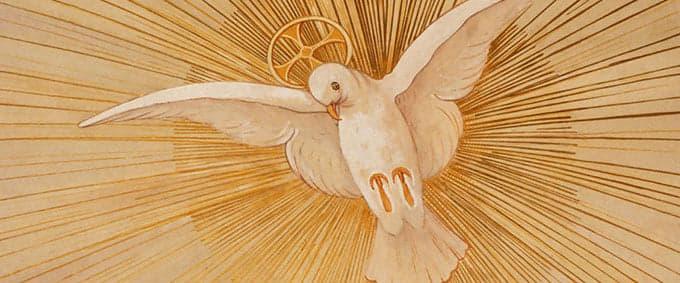

Who Is the Holy Spirit? Why We Must Know and Pray to Him Today
Whether it be a lack of catechesis or biblical know-how in the twenty-first century, staggering statistics show that most people claiming to be Christian today don’t know who the Holy Spirit is or why we must know and pray to Him. With that in mind, let us take a quick walk down history lane …
What Jesus said
During the Last Supper, Jesus said to the Apostles, “But I tell you the truth, it is better for you that I go. For if I do not go, the Advocate will not come to you. But if I go, I will send Him to you” (Jn 16:7).
Imagine the confusion for the Apostles when Jesus spoke these words. We heard from the Gospel for the Feast of the Ascension that the apostles still doubted Jesus’ divinity even as He ascended before them into Heaven. And if that was after Jesus’ death and resurrection, and the forty days of instruction that followed, imagine how lost and confused they must have been during this moment. They had yet to fully comprehend that Jesus was about to die, never mind understanding who the Advocate was, why He was coming, and why it was better that Jesus left so He could come.
Holy Spirit Hidden in Plain Sight
I think there are many times in our lives when we feel just as confused and lost as the apostles, questioning in our hearts, “Jesus, why is this better?” Why is it better that you conceal Your presence and divinity in the Eucharist? Why is it better that we receive grace through the sacraments, which can become so mundane and misunderstood? Why is it better that we have to pray for what we need if You already know? Or even, why is it better that suffering and pain—of any kind—is allowed?
That last question usually strikes at all of our hearts the hardest. Fear or disdain of pain and suffering is a fundamental motivator for all human actions or reactions. Especially in a first-world country, when every comfort or tool is at our disposal, instantly, it can be quite difficult to accept pain, loss, separation, or suffering of any kind. We so often overlook the spiritual need and requirement for suffering as much needed penance and as virtue-building. Because of this, we can no doubt understand the apostle’s confusion and fear when Jesus announced that it is better if He left. And only a solid understanding of who the Advocate is and why Jesus and the Father are sending Him to us can adequately answer that question.
What is the Trinity
The first sentence of Genesis, the very first Book of the Bible, speaks of “a mighty wind sweeping over the waters.” What follows can be easily overlooked, but it is crucial in understanding how the Trinity works. It says: “And God said, ‘Let there be light’; and there was light.”
Genesis 1:3
The Trinity is presented here within the first lines of Holy Scripture. The Creator, moving like a mighty wind, spoke to create. Let’s break it down. God the Father is the source of all life, the Creator; the Holy Spirit is His breath, the mighty wind; and the Word spoken from this breath is the Logos, the Word who became incarnate—Jesus. Throughout the history of the Church, much has been taught about the mystery of the Holy Trinity. It suffices to say that, because God is one, wherever one Person of the Trinity is, so are the other two. There are no divisions or parts in God; He is perfect, one, infinite, and good. When the Word became flesh, still no division or separation in the Trinity manifested. The Father chose to send the Son, through the power of the Holy Spirit, to become one of us. And the Son, fully God and fully man, always remained one with the Father and the Holy Spirit.
Now consider what Jesus said at the Last Supper: “It is better for you that I go. If I do not go, the Advocate will not come to you.”
A few more titles for the Persons of the Trinity will help clarify what Jesus is saying here. The First Person of the Trinity, the Father, is the Creator. The Second Person, the Son, is the Redeemer. This is His mission; the reason the Father sent the Son was to save us from our sins, which he did through his death and resurrection. But, does it end there? You should be saying, well no, because life went on. After the resurrection, a new heaven and a new earth was not immediately established. We know that for certain because there is still sin and suffering, evil and pain, death and destruction today—just look around. But, there’s also the Church.
That they may be one
Much can be said about the mystery of the Church. But the point in bringing the Church into all of this is to answer this fundamental question, did Jesus mean to establish the Church through His death and resurrection? Was the New Covenant supposed to become the Church that exists today? The answer is yes. And how do we know this? Because there is a Third Person of the Trinity. This Third Person is also known as the Sanctifier. To sanctify something means to make it holy. The mission of the Holy Spirit is to sanctify those who have been both created and redeemed – to make us perfect as our Heavenly Father is perfect (Matt. 5:48).
So why did Jesus need to go away to send the Holy Spirit? Jesus spoke about the Advocate during the Last Supper when instituting the Holy Eucharist and the priesthood. Jesus was not speaking of going away as abandonment, or as escaping to Heaven to watch us from afar. He was presenting to the apostles His Body and Blood, Soul and Divinity in the Eucharist and the ability to offer this sacrifice in His place – a sacrament that would truly come into our bodies.
What Jesus meant by going away then was leaving them as they were accustomed to being with Him—as a man walking among them as Teacher. He was leaving them as a man so that He could remain with them in a new and most intimate way in the Eucharist.
Just as in creation, when the Creator spoke words to create, so now in the Church, the Father gives us His Son through the Holy Spirit. A priest or bishop is ordained by the imposition of hands, the ancient symbol of sending the Holy Spirit upon the man. Acting in persona Christi, through the Holy Spirit, Jesus is made present to us in the Eucharist – all glory to God! And it is by our participation in the sacraments of the Church that we are, little by little, made holy — sanctified. The Holy Spirit brings us into communion with the Trinity because, remember, the Trinity cannot be divided.
Jesus continues a little later in the Last Supper discourse to His Father and says: “And I have given them the glory You gave Me, so that they may be one, as We are one, I in them and You in Me, that they may be brought to perfection as one, that the world may know that You sent Me and that You loved them even as You loved Me” (Jn. 17:22-23).
Through Him, with Him, and in Him
Looking back once again at Genesis, we see that the sin of Adam and Eve was their ‘trying to be like God’ without God. They ate the fruit so they could be like gods, knowing good and evil. The serpent (the devil) deceived them saying that God did not want them to eat the fruit of the Tree of the Knowledge of Good and Evil because He did not want them to be like Him. Thankfully, Jesus taught that this could not be farther from the truth. Through the Church, we can approach the new fruit from the tree—the Cross—and by the fruit (sacraments) become one with God.
As our Advocate, we must pray to the Holy Spirit to inspire us to live holy and fruitful lives. Just as we need Him to receive grace through the sacraments, we also need Him to use this grace to spread the message of redemption and sanctification throughout the whole world. We must trust that God knows what He is doing, even when it seems to us that this could not be the “better” way. The Cross has become our better way, and the Holy Spirit, our Advocate will ensure that we can live the abundant life that Jesus has promised is possible when we live it in, through, and with Him … which is exactly why we must start praying to Him today.
May the power of the Holy Ghost bless you mightily!

0 comments on “Who Is the Holy Spirit? Why We Must Know and Pray to Him Today”